

Education & Philosophy
Reclaiming Human-Centered Development in Early Education
This philosophy emerges from thirty years of embodied practice—at the barre, on the land, in the forest—and from years of independent study in developmental psychology. It has been tested in studios where seven-year-olds learn to hold a balance and on farms where they learn to hold uncertainty. My oldest daughter attends the school where much of this thinking has taken root.
What follows is not theory for its own sake. It is what I have come to understand about how children actually develop—and what we risk when we forget.
Development Has a Sequence
Children are not miniature adults. They are developing nervous systems, and those systems unfold in an order we did not invent and cannot rush.
In the early years, attention is scaffolded relationally—a child learns to focus because someone is focusing with her. Regulation is co-created—she borrows our calm until she can generate her own. Confidence is built through physical consequence and supported effort, not through stars on a screen. Meaning forms in shared experience, in the texture of real days with real people.
When we introduce abstraction before embodiment, or devices before self-regulation, we reverse that sequence. We ask children to manage tools before they can manage themselves. We offer answers before they have felt the weight of questions.
Before a child can manage a device, she must learn to manage herself. Before abstract knowledge stabilizes, she must feel competent in what is real and resistant—things that push back, that require adjustment, that do not auto-correct.
This is not nostalgia. It is neurological timing. And when we honor it, children thrive in ways that feel almost inevitable. When we violate it, we spend years trying to repair what was simply mis-sequenced.
The Body Is the First Teacher
Children arrive already knowing things. I call this Chronosomatic Intelligence—the body's sense of rhythm, readiness, and pacing. Watch a toddler pull away when overwhelmed. Watch a six-year-old lean in when she's ready to stretch. They know. The body knows before the mind has language for it.
Our task is not to override that intelligence with premature abstraction. It is to honor it, refine it, and help children learn to trust what they already sense.
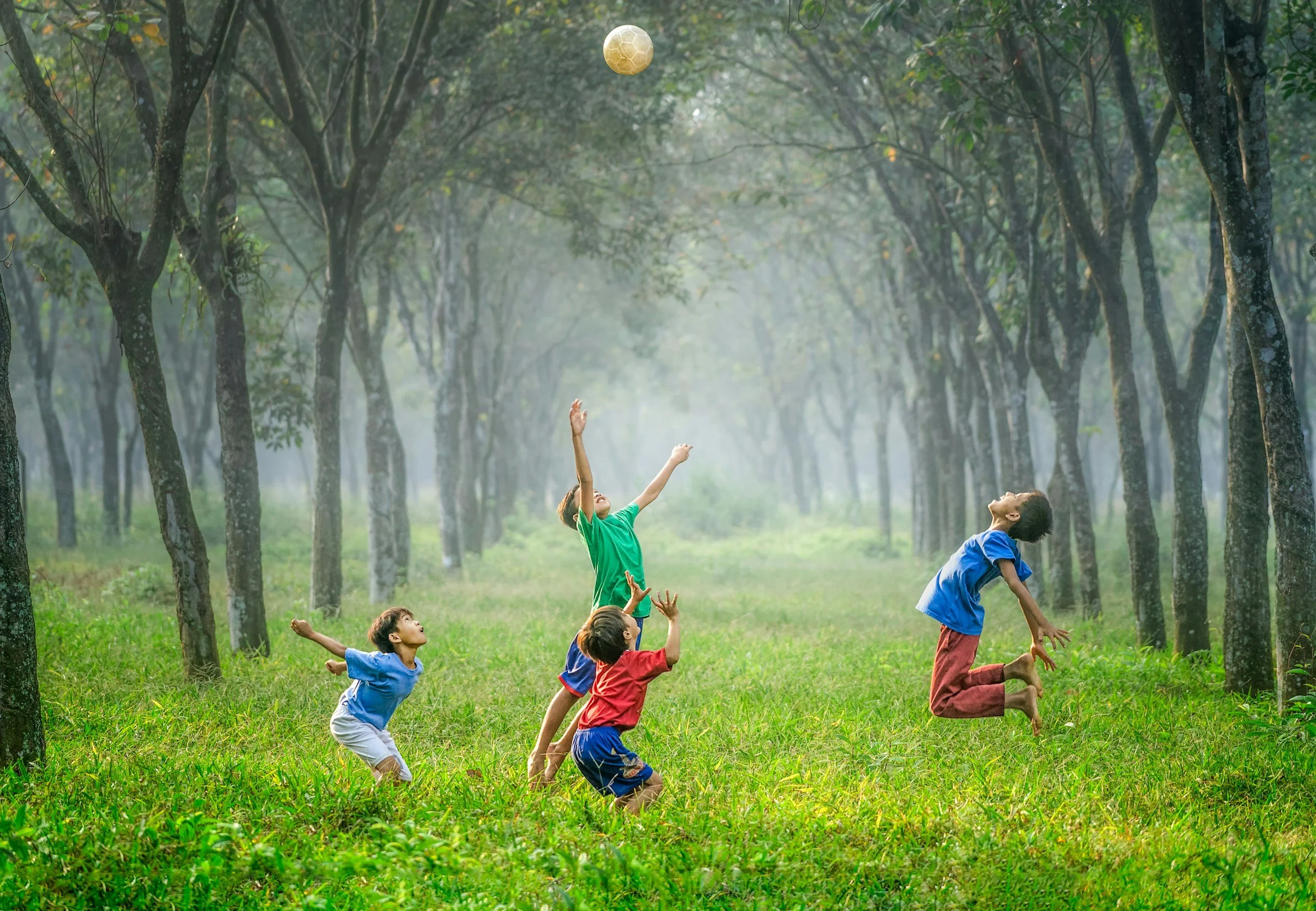
This is why they need daily contact with the material world. Uneven ground under their feet. Tools that require grip and adjustment. Weather that changes plans. Tasks that matter and don't forgive sloppiness.
When a child carries water across a field, or builds something that might fall, or navigates terrain that asks her to adapt—she is not just "doing an activity." She is building the architecture of her own competence:
Executive function, through sequenced action that has to happen in order. Emotional regulation, through difficulty that is manageable but real. Spatial reasoning, through physical consequence she can feel. Confidence that is earned—not performed, not given, not gamified.
The physical world offers honest feedback. It does not inflate success or soften failure. That honesty is a gift. It teaches children that they can adapt, recover, try again—and that the trying is what makes them capable, not the applause.
Early Patterns Shape Everything That Follows
Here is something I wish more people understood: children are not just learning content. They are forming patterns—of attention, of response, of orientation toward difficulty.
I think of these patterns as gravitational. Once they form, they bend attention toward the familiar. A child who learns "hard things break me" will find her attention pulled toward evidence of that. A child who learns "hard things are survivable, especially with help" will orient completely differently toward the same challenge.
This is why early experience matters so much—not because it determines everything, but because it sets the gravitational structure of a child's inner world.
A child repeatedly rescued from difficulty learns fragility. A child repeatedly supported through difficulty learns endurance.
Same child. Different shaping.
My curriculum deliberately builds patterns of competence, adaptability, and relational trust. I want children to develop an internal structure that pulls them toward curiosity rather than avoidance, toward effort rather than collapse.
And here is the hopeful part: small, repeated experiences of supported mastery create momentum. I call it escape velocity—the accumulated force that lets a child break free from a limiting pattern and establish a new one. This is not dramatic intervention. It is patient, daily work. It is the way we meet them in their struggle, again and again, until they internalize a different expectation of themselves.
Learning Is a Shared Act
Modern education increasingly funnels attention into private algorithmic streams. Headphones replace dialogue. Dashboards replace faces. Each child floats in her own current, optimized and alone.
We choose a different architecture.
Children in our care learn through shared inquiry. They ask questions together—sometimes clumsily, sometimes brilliantly. They disagree and repair. They watch each other struggle and succeed. They experience knowledge as something built in relationship, not consumed in isolation.
This is not inefficient. This is how intellectual maturity actually forms. In shared learning, children develop:
Perspective-taking—the lived experience of realizing someone else sees it differently. Intellectual humility—the discovery that being wrong is survivable and sometimes even useful. Language precision—the need to say what you actually mean when someone is listening. Courage to revise—the understanding that changing your mind is strength, not weakness.
Meaning that is made collectively stays alive. It has roots in relationship. Meaning that is delivered without relationship—through a screen, through an algorithm, without a human face—begins to drift almost immediately. The words remain, but something essential thins.
Teachers Hold the Tempo
A screen can measure correct answers. A teacher can see uncertainty before it becomes error.
This is not a small distinction. This is everything.
Children develop at different rates, in different rhythms, with different needs at different moments. They require adults who can sense hesitation, notice the furrowed brow, feel when confusion is about to tip into shutdown. This is Chronosomatic Intelligence in practice—the recognition that development unfolds in rhythms no dashboard can capture.
When tempo is controlled by systems rather than human judgment, children adapt to the machine. When teachers retain interpretive authority—when they can slow down, circle back, linger where lingering is needed—instruction adapts to the child.
The right lesson delivered at the wrong time teaches the wrong thing. I have watched this happen. A concept offered before the nervous system was ready doesn't land as knowledge. It lands as stress, as inadequacy, as "I'm not good at this." Timing is not logistical. It is developmental. And only humans can read it in real time.
Co-Regulation Precedes Independence
Here is something that sounds paradoxical but isn't: children become independent by first being deeply dependent.
Self-regulation does not develop in isolation. It develops through the steady presence of an adult who helps a child stay with difficulty rather than flee from it.
When a child struggles—with a knot, a math problem, a conflict with a friend—we do not remove the difficulty. That would rob her of the chance to learn she can survive it. Instead, we remain present. We offer our calm, our patience, our confidence that she can do this. We become the external regulation she borrows until she can generate her own.
Over time, she internalizes that steadiness. The voice that once came from outside becomes a voice inside.
This is how frustration tolerance actually forms. Not by eliminating friction, but by accompanying it. Not by solving the problem for her, but by staying close while she solves it herself.
Protecting Meaning from Drift
Children encounter powerful symbols everywhere—in stories, in media, in religion, in digital spaces. They absorb metaphors they don't yet understand. They repeat phrases that haven't yet become real to them.
Part of our work is teaching them to move between meaning and mechanism without confusion. To know the difference between a story that is true and a story that is literally factual. To understand that an intuition can inspire inquiry but must eventually be tested. To feel, in their bones, that revision is strength—not failure.
I think a lot about how meaning degrades over time. I call this Origin Drift—the way understanding moves through stages of removal from its source. What begins as living knowledge, fully inhabited, can become mere repetition if we're not careful. The words stay the same, but the meaning thins. We see this everywhere: in rituals performed without understanding, in phrases repeated without feeling, in knowledge that has become hollow.
Children need to learn to recognize where they are on that spectrum. They need to sense the difference between understanding something and merely repeating it. They need to value the living thing over its echo.
The goal is not rigid skepticism. Nor is it unquestioning belief. The goal is adaptive thinking—the capacity to hold awe and evidence in the same hand, and to keep asking which is which.
Technology Is a Tool—Not a Foundation
Technology is part of modern life. I am not interested in rejecting it.
But I am interested in sequence. And the sequence matters.
Foundational capacities must be established before digital immersion: attention that can sustain without external stimulation, regulation that doesn't require a device, relational awareness built through human faces, critical thinking practiced in real dialogue, physical competence earned through real effort.
When these capacities are stable—when the child has gravitational centers that are hers—technology can extend her intelligence without replacing it. But when we reverse the sequence, when the device enters before the foundation is set, technology becomes the organizing force. The child doesn't use the tool; the tool uses her. She develops patterns of reactivity, passivity, externalized attention.
We introduce digital tools intentionally and developmentally. Never as replacements for human presence. Always as extensions of human judgment, in the hands of children who already know who they are without a screen.
The Human We Are Forming
I am not trying to produce efficient task-completers. I am not optimizing for test scores or compliance or the kind of achievement that looks good on paper but feels hollow inside.
I am forming young people who are:
Self-motivated—who move toward challenge because they have learned challenge is survivable. Capable of sustained effort—who can stay with something hard because they have practiced staying. Emotionally intelligent—who have been helped to feel, not trained to suppress. Attuned to others—who learned in shared space, not private streams. Comfortable revising their beliefs—who know that changing your mind is how you grow. Respectful of the natural world—who have worked with soil and weather and living things. Thoughtful users of technology—who know it as a tool, not a home. Capable of leading without dominating—who understand that real authority is relational.
Children whose internal patterns orient toward growth rather than avoidance. Who can meet uncertainty without collapse. Who trust their bodies, think critically, collaborate deeply, and care about the world they are inheriting.
This is the work. It is slow, and it is daily, and it is human. And I believe it is the most important thing we can do.

The curriculum is a practice of becoming emotionally literate enough to live in integrity. It is designed to help children feel clearly, communicate honestly, and navigate the world with a grounded sense of self-trust. It draws from developmental psychology, trauma-informed care, somatic awareness, storytelling, and a deep belief in children’s natural intelligence. It is gentle in tone but fierce in intention.
Here’s what lives at the heart of it…
Discernment-Based Emotional Literacy
Children are taught to feel more clearly. We use real emotional vocabulary, beyond happy, mad, and sad to name the subtleties between frustration, grief, and shame.
We ask: Where do you feel that in your body? What does it want you to know? What’s underneath it?
We teach children how to distinguish between emotions and reactions. This is emotional education rooted in inner truth.
Somatic Awareness & Nervous System Tools
Feelings aren’t just thoughts; they’re sensations. And children know that until it’s trained out of them. We bring the body back online through movement, breath, stillness, and play.
Children learn to recognize the signals of safety and stress within their own systems without shame. This isn’t only about “calming down.” It’s about building a relationship with the body as oracle, ally, and compass.
Authentic Expression & Relational Integrity
We don’t tell children to be nice. We teach them to be true and kind within that truth. We model boundaries that are firm and loving. We role-play emotional honesty: “I feel angry and I’m not ready to talk yet,” or “That crossed my line.”
We explore how to repair when rupture happens without force, guilt, or scripts. This is not life as an emotional performance. This is practice for honest, authentic living.
Creative Integration & Storytelling
Children learn through story, symbol, and play. We use myth, art, movement, music, and imagination to help emotions move and integrate.
Feelings don’t just get talked about. They get danced, painted, whispered, drummed. Art becomes language. Movement becomes medicine, and silence becomes sacred.
Discernment as Compass
Above all, children are invited to listen inward.
What feels true to you?
What do you know in your bones?
What’s your “yes” and what’s your “no”?
Can you feel when something’s off, even if everyone else says it’s fine?
This is where freedom begins, not in doing what’s right, but in knowing what’s true.
This curriculum is designed for parents, educators, therapists, and anyone who believes that children are not fragile, but rather ferociously wise. They don’t need us to fix them, but they do need us to remember ourselves beside them.
A home for those guiding children with presence.
Whether you're a parent walking alongside your child or an educator holding space in the classroom or studio, Threads of Becoming offers a soulful path through childhood. This branch of Infinite Threads honors the sacred unfolding of the young soul through rhythm, movement, and imagination.
Here you’ll find two woven offerings:
Enchanted Threads – a seasonal, story-rich curriculum of movement and art for young children
Embodied Threads – a developmentally aligned approach to ballet and private coaching for young dancers
Both are rooted in reverence for children's inner lives and the deep work of those who guide them.